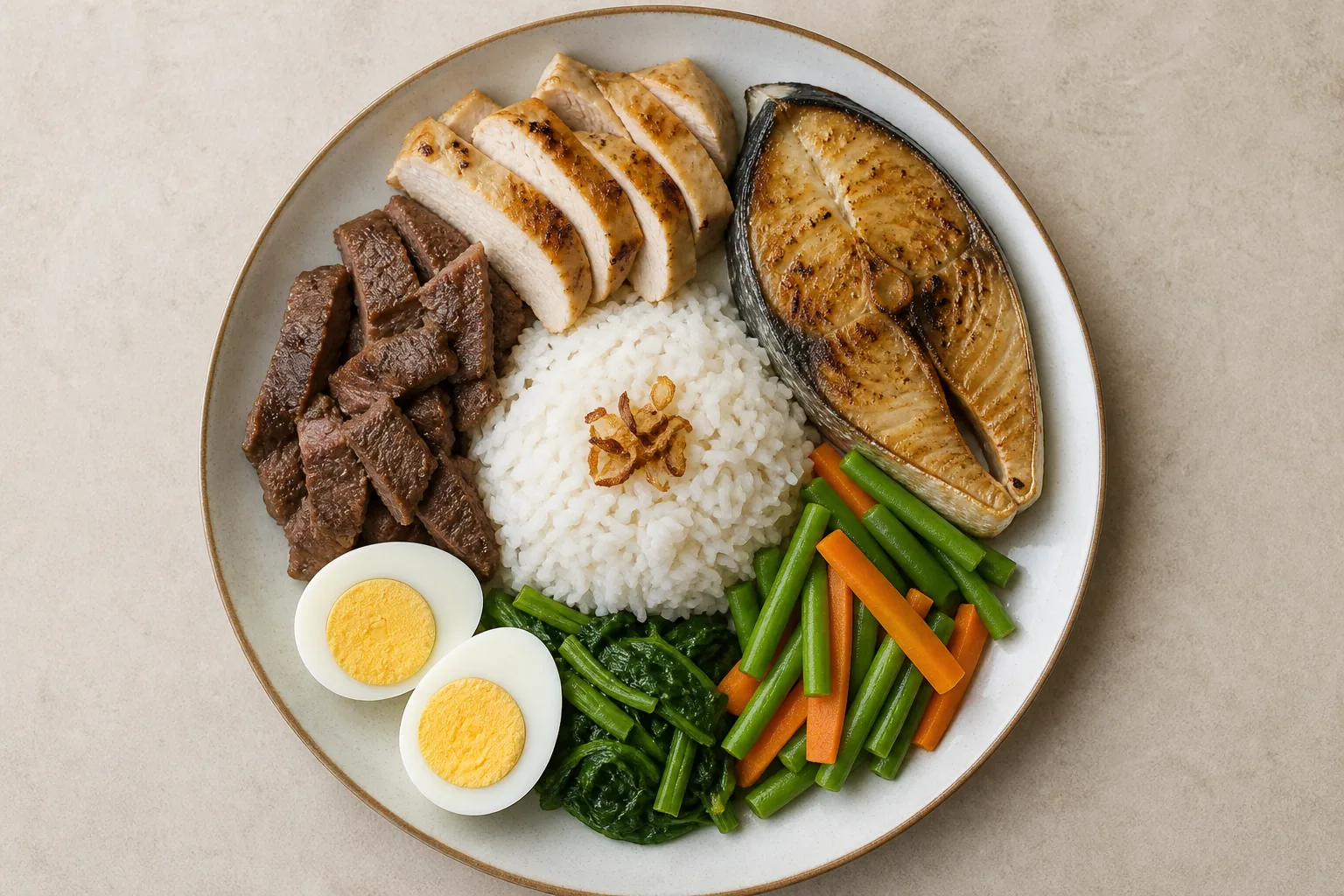
TL;DR — Creatine in Food
Creatine is found naturally in animal-derived foods — primarily red meat, fish, and poultry.
The richest food source is herring at 6.5-10g per kg of raw meat, followed by pork (5g/kg), beef (4.5g/kg), and salmon (4.5g/kg).
However, cooking reduces creatine content by approximately 25-30%, and the average omnivorous diet only provides about 1-2g of creatine per day (Kreider et al., 2017) .
To match a standard supplemental dose of 5g per day, you would need to eat roughly 1-1.5 kg of raw red meat or fish daily — clearly impractical and expensive.
Fruits, vegetables, grains, and legumes contain zero creatine.
This is why supplementation exists: it provides a practical, cost-effective way to achieve the creatine levels that food alone cannot deliver.
Creatine Content in Foods: Full Table
The following table shows the creatine content of common foods, listed per kilogram of raw weight and per typical serving size.
These values represent raw, uncooked amounts — cooking will reduce them by approximately 25-30%.
| Food | Creatine per kg (raw) | Typical Serving Size | Creatine per Serving (raw) |
|---|---|---|---|
| Herring | 6.5–10.0g | 150g fillet | 1.0–1.5g |
| Pork | 5.0g | 200g chop | 1.0g |
| Beef | 4.5g | 200g steak | 0.9g |
| Salmon | 4.5g | 150g fillet | 0.7g |
| Tuna | 4.0g | 150g steak | 0.6g |
| Cod | 3.0g | 150g fillet | 0.5g |
| Chicken breast | 3.4g | 200g breast | 0.7g |
| Turkey | 3.0g | 200g breast | 0.6g |
| Rabbit | 3.4g | 200g portion | 0.7g |
| Lamb | 4.0g | 200g chop | 0.8g |
| Venison | 4.5g | 200g steak | 0.9g |
| Shrimp/Prawns | trace | 150g | trace |
| Milk | 0.1g | 250ml glass | 0.03g |
| Cranberries | trace | 100g | trace |
| All other fruits | 0g | — | 0g |
| All vegetables | 0g | — | 0g |
| Grains & legumes | 0g | — | 0g |
Top Creatine Foods Ranked
Let us look at the top dietary sources of creatine in more detail:
1. Herring (6.5-10g/kg raw) Herring is the undisputed champion of creatine-rich foods.
A 150g serving of raw herring provides 1.0-1.5g of creatine — more than any other common food per serving.
However, herring is not a daily staple for most people, and the wide range in creatine content reflects variability between fresh, pickled, and smoked preparations.
2. Pork (5g/kg raw) Pork is one of the richest terrestrial sources of creatine. A standard 200g pork chop provides approximately 1g of creatine before cooking.
Pork tenderloin, loin chops, and other lean cuts all contain comparable creatine levels.
3. Beef (4.5g/kg raw) Beef is the most commonly cited creatine food source, and for good reason — it is both creatine-rich and a dietary staple in many cultures.
A 200g steak provides roughly 0.9g of creatine before cooking.
The creatine content is similar across different cuts (sirloin, ribeye, tenderloin).
4. Salmon (4.5g/kg raw) Salmon matches beef gram-for-gram in creatine content and provides the additional benefits of omega-3 fatty acids.
A 150g salmon fillet yields approximately 0.7g of creatine.
Wild-caught and farmed salmon have comparable creatine levels.
5. Tuna (4g/kg raw) Tuna is another excellent fish source of creatine.
Fresh tuna steak contains more creatine than canned tuna, as the canning process (which involves cooking) reduces creatine content.
A 150g fresh tuna steak provides approximately 0.6g.
6. Cod (3g/kg raw) Cod and other white fish contain meaningful but lower amounts of creatine compared to oily fish.
A 150g cod fillet provides about 0.5g of creatine before cooking.
7. Chicken (3.4g/kg raw) Chicken breast contains a moderate amount of creatine — less than red meat but still a meaningful dietary contributor given how frequently chicken is consumed.
A 200g chicken breast provides approximately 0.7g of creatine before cooking.
How Cooking Affects Creatine Content
One of the most important and frequently overlooked factors in dietary creatine is the impact of cooking.
When meat or fish is cooked, a significant portion of the creatine is degraded or lost.
Overall loss: approximately 25-30% during typical cooking
The degradation occurs through two main mechanisms:
-
Thermal degradation. Heat converts creatine into creatinine (a metabolic waste product) through a process called dehydration cyclization. The higher the temperature and the longer the exposure, the more creatine is converted to creatinine and lost.
-
Leaching into cooking liquid. When meat is boiled, stewed, or braised, creatine dissolves into the surrounding liquid. If this liquid is consumed (as in a soup or stew), some creatine is recovered. If the liquid is discarded, the creatine is lost entirely.
Cooking method comparison:
| Method | Approximate Creatine Loss | Notes |
|---|---|---|
| Raw (sashimi, tartare) | 0% | Maximum creatine retained |
| Steaming | 10-15% | Gentle heat, minimal leaching |
| Poaching | 15-20% | Low temp, some leaching into water |
| Baking/Roasting | 20-25% | Moderate heat, longer exposure |
| Pan-frying | 25-30% | Higher temp, shorter time |
| Grilling/BBQ | 25-35% | High heat, direct flame |
| Deep frying | 30-35% | Very high temp |
| Boiling (liquid discarded) | 30-40% | Leaching + thermal loss |
| Boiling (liquid consumed) | 15-20% | Leaching recovered via broth |
Practical takeaway: If maximizing dietary creatine is a goal, favor gentler cooking methods (steaming, poaching) over intense heat methods (grilling, deep frying).
Consuming cooking liquids (soups, stews, gravies) helps recover creatine that leaches into the liquid during cooking.
However, even with optimal cooking methods, dietary creatine alone cannot reach supplemental levels — the gap is too large.
Diet vs Supplement: The Math
This is the fundamental question: can you get enough creatine from food alone to match the benefits of supplementation?
Let us run the numbers.
Supplemental dose: The standard effective dose confirmed by research is 3-5g of creatine per day for the maintenance phase.
Dietary intake: The average omnivorous diet provides approximately 1-2g of creatine per day — roughly half from meat and half from fish, with trace amounts from dairy.
The gap: To get 5g of creatine from food, you would need to consume approximately:
- 1.1 kg of raw beef (0.8 kg after accounting for cooking loss) — that is roughly four large steaks per day
- 0.75 kg of raw herring — about five generous herring fillets per day
- 1.5 kg of raw chicken breast — nearly seven chicken breasts per day
This is clearly impractical for several reasons.
The sheer volume of meat required would push your daily protein intake far above what most people need or want.
The caloric load would be enormous — 1 kg of beef alone is roughly 2,500 calories.
The cost would be significant compared to creatine supplementation, which costs approximately RM0.50-1.50 per day.
And the cooking process would reduce the creatine content further, meaning you would need even more raw material.
Cost comparison:
| Source | Daily Cost for 5g Creatine | Practical? |
|---|---|---|
| Raw beef (~1.1 kg) | RM30-50 | No |
| Raw salmon (~1.1 kg) | RM40-70 | No |
| Raw chicken (~1.5 kg) | RM15-25 | No |
| Creatine supplement (5g) | RM0.50-1.50 | Yes |
Supplementation wins on every practical metric: cost, convenience, precision of dosing, and caloric efficiency.
A 5g scoop of creatine monohydrate has zero calories, costs under RM2, and delivers the exact dose you need.
Food cannot compete on these terms.
Malaysian Diet Context: Creatine in Everyday Meals
For Malaysian readers, it is useful to estimate how much creatine you are getting from common local dishes.
Keep in mind these are rough estimates based on typical portion sizes and ingredient weights, with cooking losses factored in:
Rendang daging (beef rendang) A typical serving contains approximately 150-200g of cooked beef.
After accounting for cooking losses (slow-cooked for hours, significant thermal degradation), the creatine content per serving is estimated at 0.4-0.6g.
Ikan bakar (grilled fish) A standard ikan bakar portion (150-200g of grilled fish such as kembung, tenggiri, or siakap) provides approximately 0.3-0.5g of creatine after grilling losses.
Ayam goreng (fried chicken) A typical fried chicken portion (1-2 pieces, approximately 150-200g of meat) provides approximately 0.3-0.5g of creatine after deep-frying losses.
Nasi lemak with ayam The chicken component of a standard nasi lemak provides roughly 0.2-0.4g of creatine depending on the cooking method and portion size.
Sup tulang (bone soup) Interestingly, bone-based soups may retain more creatine than other cooking methods because the creatine that leaches from meat into the broth is consumed rather than discarded.
A bowl of sup tulang with meat pieces may provide 0.4-0.7g of creatine.
Daily estimate for a typical Malaysian omnivore: Across all meals in a day, a Malaysian eating a typical mixed diet likely consumes approximately 0.8-1.5g of creatine — consistent with the global average of 1-2g per day for omnivores.
This is well below the 3-5g supplemental dose that research has shown to improve performance and muscle creatine saturation.
Creatine for Vegetarians and Vegans
This is where the dietary creatine conversation becomes particularly significant.
Vegetarians and vegans consume little to no dietary creatine — their intake is effectively zero from food sources, relying entirely on their body’s endogenous production of approximately 1-2g per day.
Research consistently shows that vegetarians have:
- Lower muscle creatine stores compared to omnivores (by approximately 20-30%)
- Lower brain creatine levels
- Greater response to creatine supplementation (larger relative improvements in strength and cognitive function)
This makes vegetarians and vegans the population group that stands to gain the most from creatine supplementation.
The difference between a vegetarian’s baseline creatine stores and fully saturated stores is larger than for an omnivore, which translates to a greater absolute improvement when supplementation begins (Kreider et al., 2017) .
For vegetarians and vegans in Malaysia — including those following plant-based diets for health, ethical, or religious reasons — creatine monohydrate supplementation is one of the most evidence-backed additions they can make to their nutrition plan.
Creatine monohydrate is vegan-friendly (it is synthetically produced from chemical precursors, not derived from animal tissue), making it fully compatible with plant-based diets.
Endogenous creatine production: Your body synthesizes creatine from three amino acids: glycine, arginine, and methionine. This process occurs in the liver, kidneys, and pancreas regardless of diet.
However, this endogenous production (1-2g/day) only partially saturates muscle creatine stores.
Supplementation is needed to achieve full saturation regardless of dietary pattern — it is simply even more impactful for those who receive zero creatine from food.
Sources & References
This article references the ISSN Position Stand on Creatine (Kreider et al., 2017) for creatine content in foods and the scientific basis for supplementation recommendations.
Creatine content values are drawn from published food composition data (Harris et al., Balsom et al.) and USDA nutrient databases.
Malaysian food estimates are calculated from standard portion sizes and established creatine degradation rates. Full citations with DOI links are available in our Research Library.